
For data-driven platforms, the API is the product. When your core value proposition involves empowering customers to fetch complex data structures, your documentation cannot simply be a reference manual; it must be an active onboarding engine.
It’s a common challenge: its documentation is technically accurate but could be easier to use. Here are a few areas that would instantly improve,
An Overview Before the Start
In the traditional documentation view, a developer’s first interaction with the API was often the weakest. Docuwiz introduces a Capability Overview page. This is a fundamental shift from “API Reference” to “Developer Portal.” Instead of jumping straight into endpoints, the documentation would open with a structured narrative:
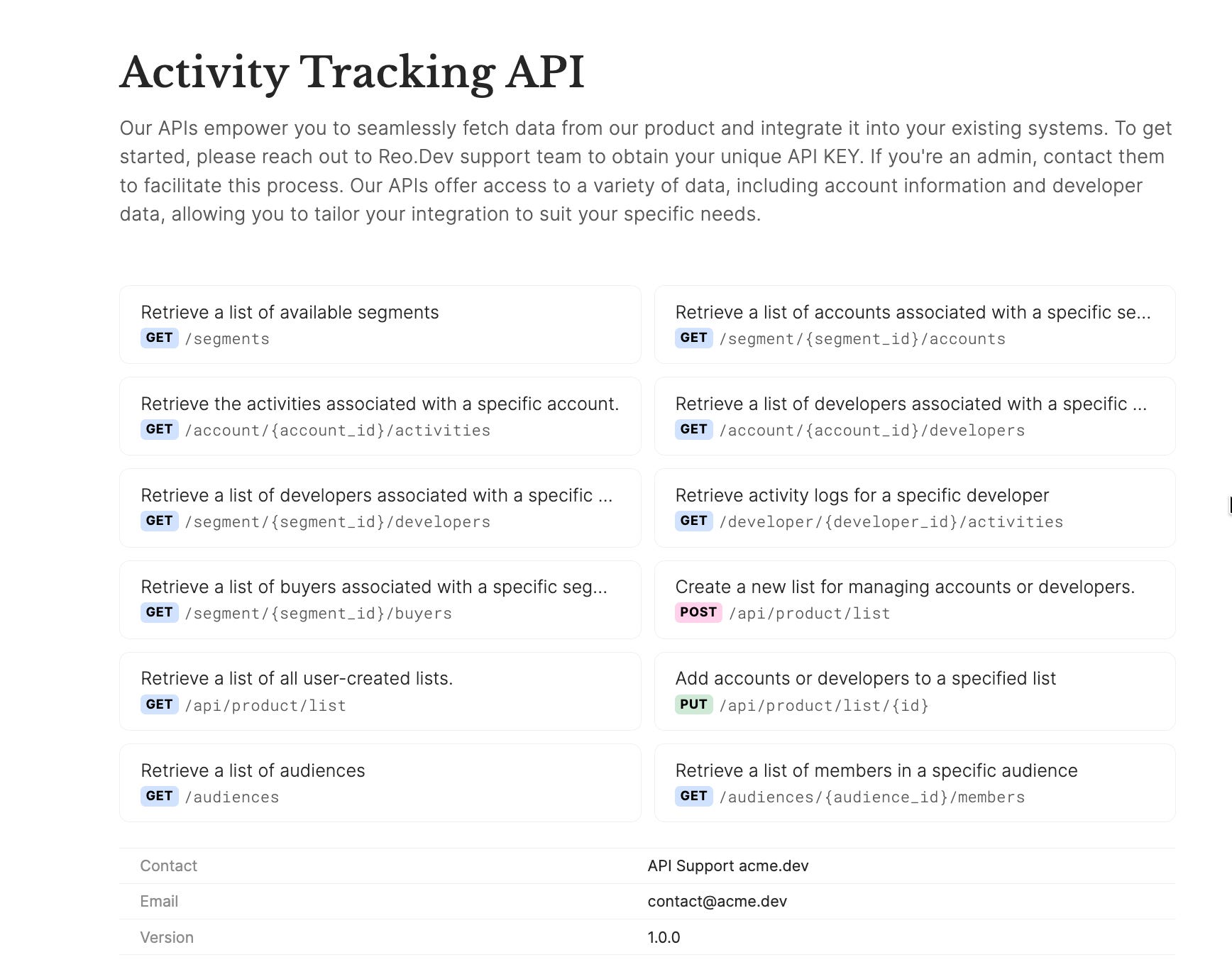
Why It Matters
By providing a high-level map and clear authentication steps immediately, you anchor the user. You give them the confidence that the platform is mature and easy to use. This seemingly simple addition is often the difference between a user who bounces and a user who integrates.
2. Auto-Detailing: Saving Hours of Refinement
The single biggest time-sink in API documentation is writing descriptions for standard parameters. Every API has them: page, limit, sort, id, created_at. In the original documentation, the description for the page parameter was minimal:
BEFORE: “Page number of Segments List”
This description is technically accurate but it leaves developers with questions:
“Is it 0-indexed or 1-indexed?”
“What happens if I don’t send it?”
“Is there a maximum value?”
To answer these questions, a developer usually has to try the API and see what happens, a “trial and error” approach.
After (With Docuwiz):
Docuwiz’s AI-Driven Auto-Detailing engine would automatically analyze the context of API and enrich these descriptions without manual intervention. The result would be a description that anticipates developer questions:
page: “Page number for pagination purposes. Must be a positive integer. If unspecified, the default page is 1.”
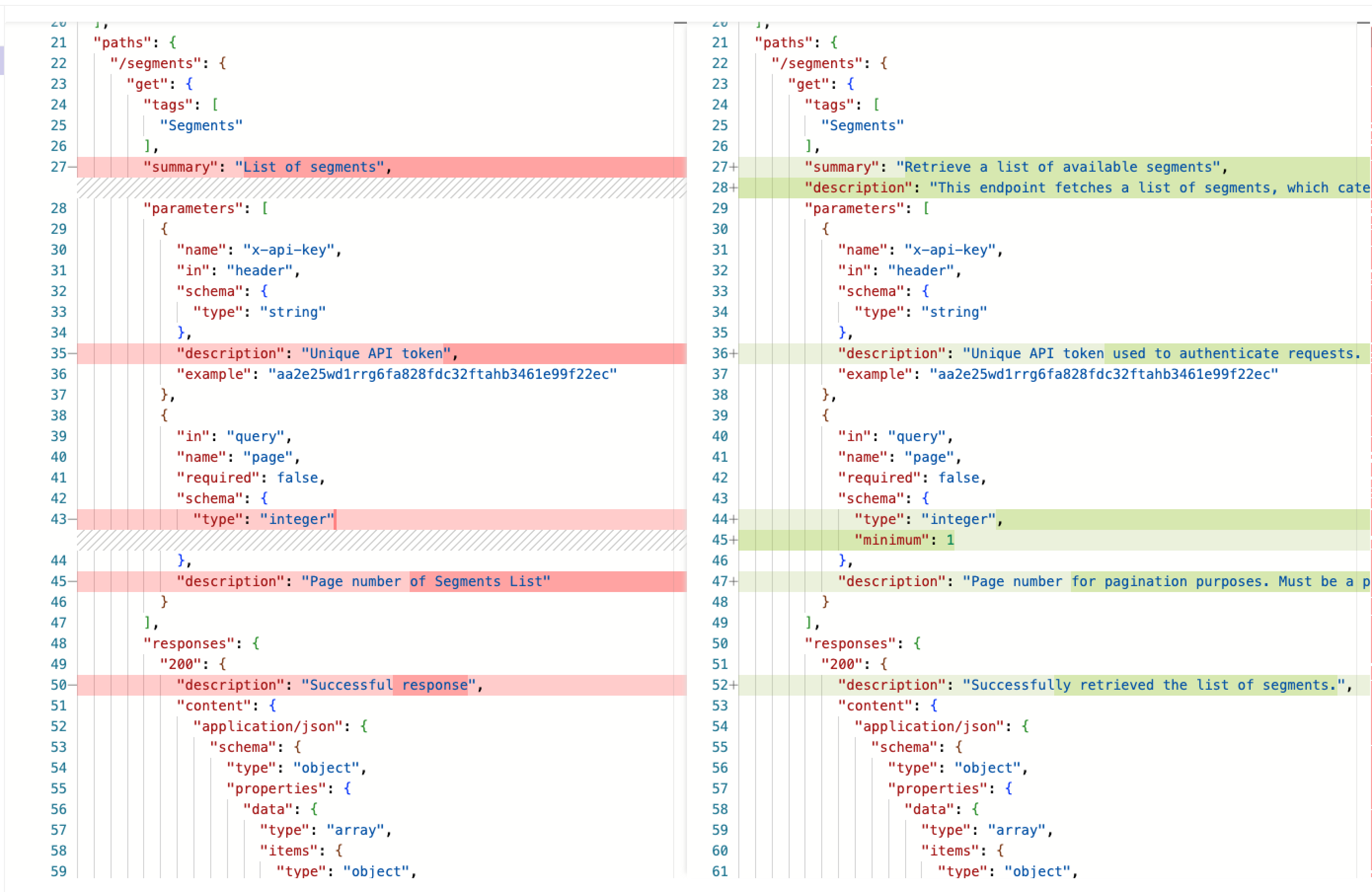
This approach gives,
Constraint Clarity: “Must be a positive integer” prevents
page=0errors.Default Handling: “If unspecified, the default page is 1” allows for simpler queries.
Context: “for pagination purposes” reinforces the parameter’s role.
Why It Matters
Save hours of “documentation grooming.” More importantly, they would achieve perfect consistency. Every
pageparameter across the entire API would share the same high-quality description style, building subconscious trust with the developer.
3. The Missing Context
“List of Buyers” vs “Buyers in a Segment”
In the current documentation, the endpoint is simply labeled “List of buyers”. A developer seeing GET /segment/{segment_id}/buyers might guess the relationship, but the documentation doesn’t explicitly explain how the buyers are filtered. It fails to communicate that this list is contextual to the specific segment_id provided in the path
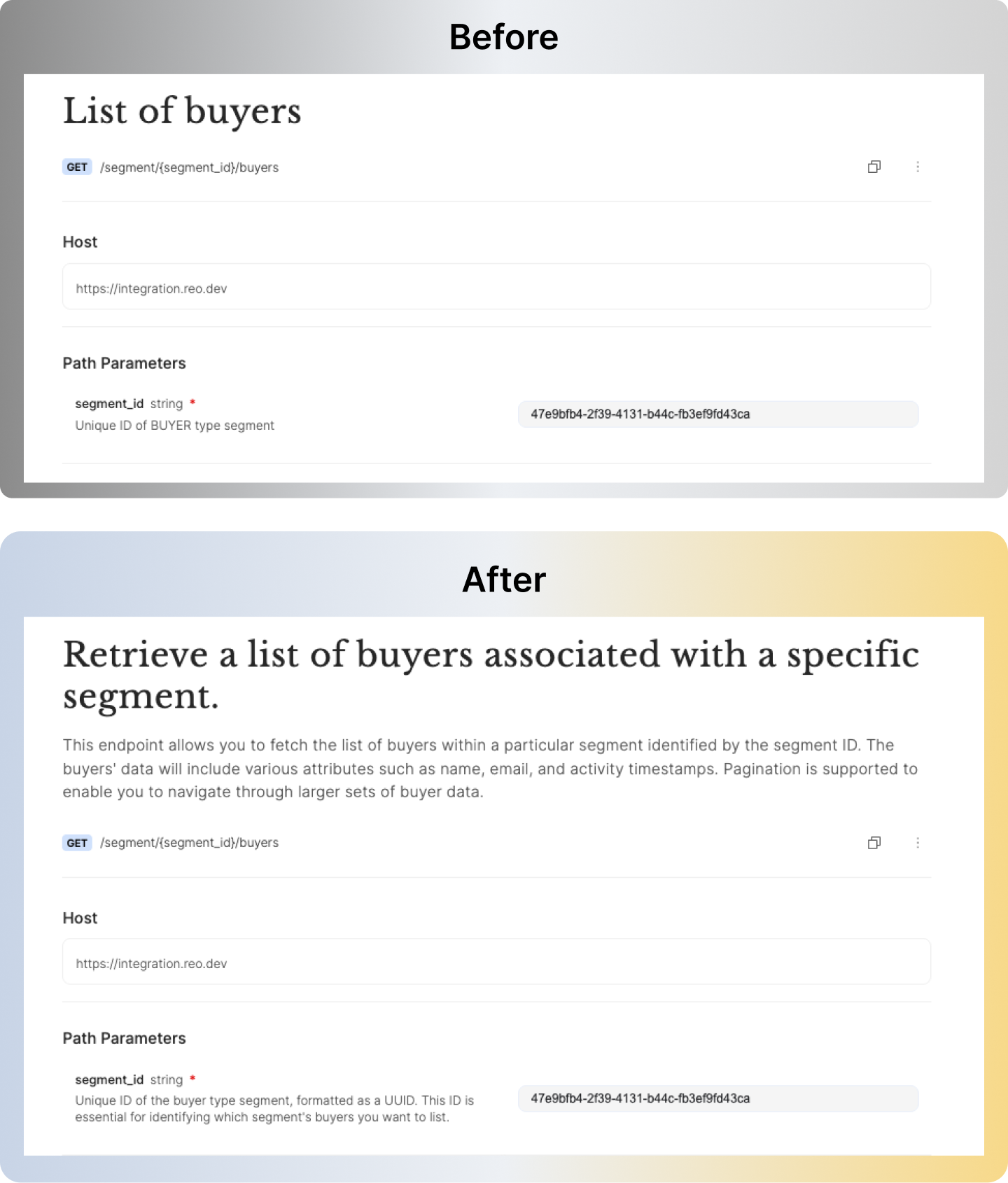
What Docuwiz would do:
Docuwiz would transform this title into a clear value statement: “Retrieve a list of buyers associated with a specific segment.”
It would then explicitly explain the relationship in the description: “This endpoint allows you to fetch the list of buyers within a particular segment identified by the segment ID.”
Why It Matters:
Ambiguity forces developers to make assumptions. Without this context, a developer might wonder if this endpoint returns all buyers or just some. By clarifying the “segment” relationship upfront, Docuwiz eliminates guesswork and confirms the developer is using the right tool for the job.
3. Markdown Support in Operation Descriptions
API operations often require detailed explanations with multiple paragraphs, code snippets, and ordered lists. Docuwiz would render these descriptions with full markdown support, transforming dense blocks of plain text into structured, readable guides
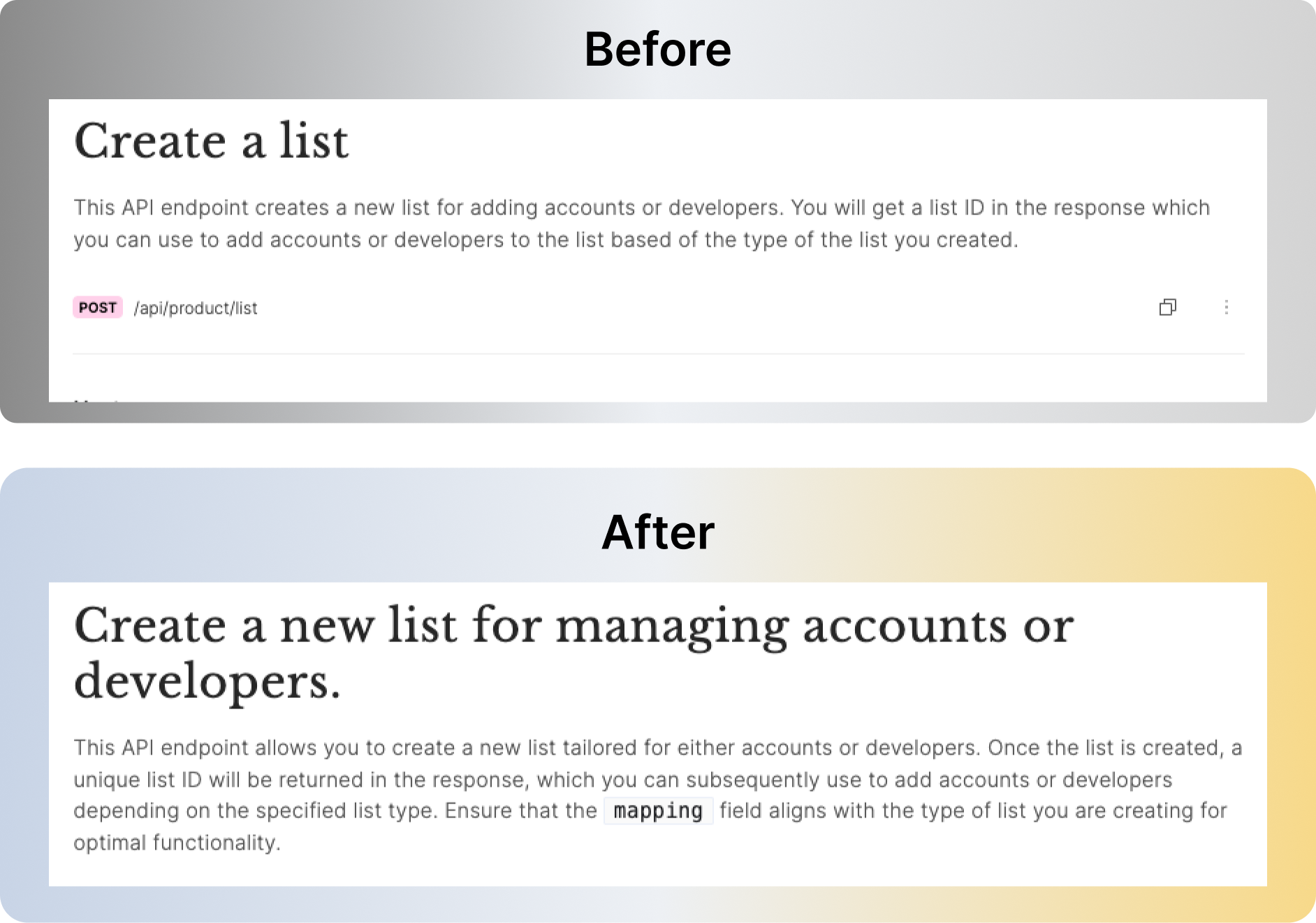
In API descriptions, a word can be an English noun (e.g., “mapping”) or a strict technical parameter (mapping). Docuwiz allows the use of inline code styling for technical terms directly within the description text. As seen in the Create a List endpoint, the word mapping would be visually distinct from the surrounding sentence, instantly signaling that it is a specific field name that requires attention.
4. Visualizing Complex Data Structures
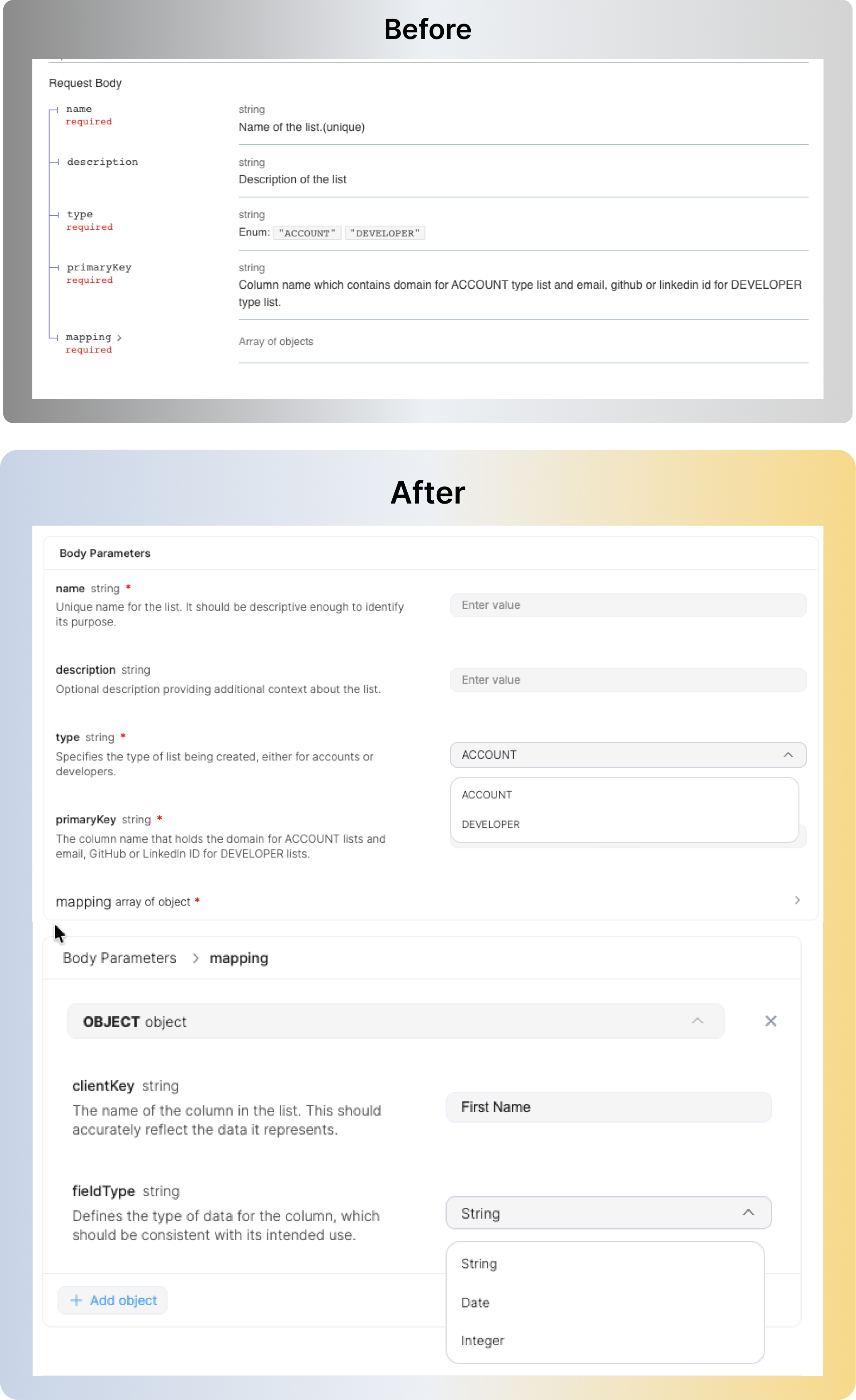
Structured Clarity for Request Bodies
Docuwiz renders these recursive structures with clear indentation and type definitions. The documentation wouldn’t just say “Array of objects”; it would visually demonstrate the hierarchy, showing exactly where the mapping array fits within the broader Body Parameters.
Why It Matters:
Constructing complex JSON bodies is prone to syntax errors. By mirroring the structure of the JSON in the documentation layout itself, Docuwiz gives developers a blueprint they can follow with confidence, reducing the time spent debugging “400 Bad Request” errors.
Make Errors Actionable
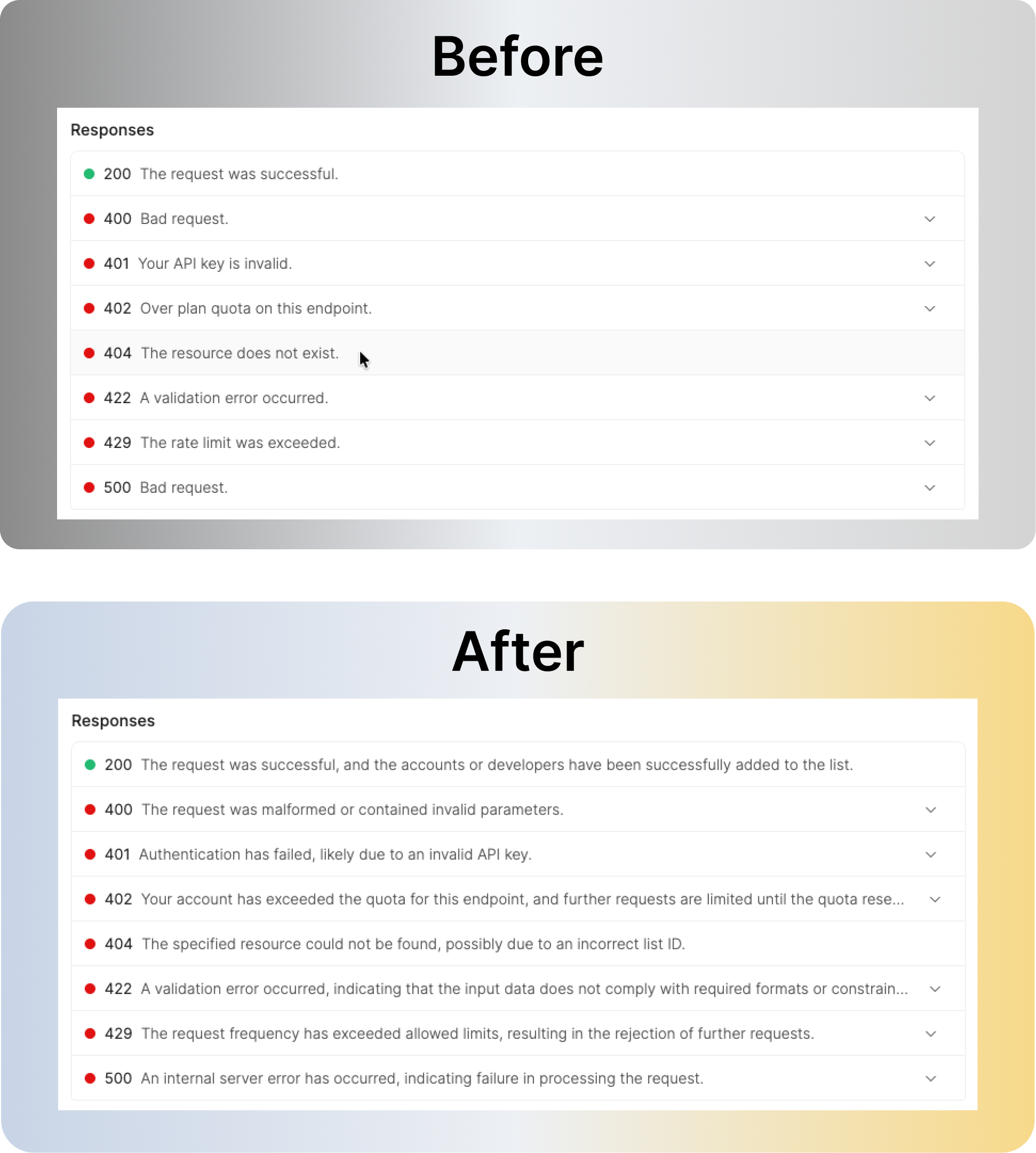
At first glance, both examples list the same HTTP status codes. But the difference lies in how much context they give to the developer. And in API design, context is what turns an error into an action.
BEFORE: Explains What Happened, Not Just What Failed
On the left, responses are technically correct, but shallow:
“401 Your API key is invalid.”
“404 The resource does not exist.”
These tell you something went wrong, but not enough to diagnose it quickly.
AFTER: , each message adds clarity:
“Authentication has failed, likely due to an invalid API key.”
“The specified resource could not be found, possibly due to an incorrect list ID.”
Now the developer knows:
Where to look
What might be wrong
What to verify next
Conclusion:
By addressing these three specific friction points, they could achieve measurable improvements across their engineering and customer success organizations:
Retention: By solving the “Blank Slate” problem, they would reduce the bounce rate for new developers, effectively lowering their Customer Acquisition Cost (CAC).
Velocity: By automating parameter descriptions , they would reclaim hundreds of engineering hours per year, allowing their team to ship features faster.
Support Deflection: By clarifying technical constraints with markdown, they would reduce the volume of “Level 1” support tickets, freeing up their support team to focus on high-value customers.
The result is documentation that doesn’t just describe the API—it sells it, supports it, and scales it.
Ready to transform your API documentation into a competitive advantage? Get started with Docuwiz today.